Daria Ep. 1 “The Esteemsters” or “Daria Needs a Jane”

I’ve heard the internet say that Daria indoctrinated a generation of eccentric, tween girls into the cult of man-hating slackerdom. But personal experience tells me that Daria did not exploit my teen angst to implant a subversive worldview—she unearthed the sardonic feminist lying dormant within, quietly anticipating the upheaval of adolescence to make herself known.

Origins

Many modern works of fiction whether poignant, cultural commentary or cringey, G-rated cow dung, begin as capitalistic endeavors and Daria, MTV’s spin-off of Beavis and Butt-head, was no different. As co-creator Susie Lewis recalled in a 2024 interview with Twelve Snakes, talks of the series began in ’96, when MTV’s animation department was taking off, and executives wanted to cash in on a “Beavis and Butt-Head for girls.”

But what started as a metaphorical Pied Piper, luring alternative girls to a consumerist playground of Walkmans and combat boots, evolved into a satirical critique of capitalist conditioning in public schools, a cutting-edge portrait of adolescent life in existentially bankrupt suburbia, and, most importantly, an exploration of intimate female friendship that renounced boy worship for a shared point of view and an undying love for pizza.

Episode 1: The Esteemsters

Welcome to Lawndale

“The Esteemsters” begins in a moving car, a visual cue that this story is taking Daria and her audience away from the crude world of Beavis and Butt-Head and into something sharper, something more refined. Daria is no longer a squiggly, half-baked sidekick. She is the fully realized, illegitimate love child of Velma Dinkley and Janeane Garofalo, here to rebrand girl geeks as riot grrrl rebels.

We learn that Daria and her family have left Highland, Texas for Lawndale, an affluent mid-Atlantic suburb in an unnamed state. As Jake, Daria’s emotionally intense father, offers a pep talk about making new friends, Daria cracks wise in the backseat, “speak up, Dad,” she quips as she turns up the volume on the radio.

Meanwhile, her younger sister, Quinn—an animated Cher Horowitz in a pink baby tee—primps in anticipation of the unpopulars who will worship at the altar of her charm.

As soon as the car stops, Quinn is swarmed by adoring fans she hasn’t even met yet: “cool shirt,” “cool name,” “will you go out with me?”— they coo as she flips her hair and giggles.

Daria, emerging from the car like an afterthought, promises her dad to help Quinn through this difficult period of adjustment.

The Lawndale Industrial Complex: Where Individuality Goes to Die

Inside the walls of Lawndale High, we experience the condescension and “whistle while you work” capitalist grooming that American public high schools are designed to impose. Principal Angela Li—authoritarian, image-obsessed, and corporate to the bone—welcomes a gaggle of new students with the forced enthusiasm of someone who knows optics are everything. To no one’s surprise, Lawndale High’s “warm welcome” comes with a mandatory psychological evaluation designed to weed out students with subversive attitudes. Certainly, this is a tool for self-improvement, not an ideological sorting mechanism.

Echoing a pivotal scene from 1976’s Carrie, in which the school principal meets with Carrie to discuss her radically disruptive behavior, then dismissively and repeatedly refers to her as “Cassie,” the Lawndale school psychologist, Mrs. Manson, continually addresses Daria as “Dara.” Signaling a subversion of the original story in which Daria, like the cruelly alienated Carrie, unleashes a fatal attack on the system that underestimated her, this scene lets us know that Daria will not be tolerating transparent attempts to intimidate or control her.

Holding up an illustration of two people talking, Mrs Manson instructs the girls to describe what they see. Quinn, a born politician, understands that the system exists to be manipulated, and responds with the banalities expected of a typical teenage girl. Daria, on the other hand, offers up a patronizing pageant response about puppies, to which Mrs. Manson scoffs in frustration.

Later, in history class, we are introduced to Mr. DeMartino, a hostile scream of a human being who must share DNA with Charlie Sheen.

He introduces Daria to the class, his caffeine- fueled eyeball rattling crudely in its socket, and immediately quizzes her:

Mr. DeMartino: “Daria! Can you concisely and unemotionally sum up for us the doctrine of Manifest Destiny?”

Daria: “Manifest Destiny was a slogan popular in the 1840s. It was used by people who claimed it was God’s will for the U.S. to expand all the way to the Pacific Ocean. These people did not include many Mexicans.”

When his reach for intellectual superiority leaves him empty-handed, he moves onto school quarterback, Kevin Thompson, who supposes that Manifest Destiny was part of Operation Watergate during the Vietnam War.


Show a Little Trust

At home, the dinner conversation turns to the first day of school. It seems that while Daria spent the day incurring the bitterness of every school authority at Lawndale High, Quinn accepted an official position as the vice president of the fashion club. She’s also considering joining the pep squad, but she’s not sure it will fit into her schedule.

As the family pokes at their lasagna, Helen, Daria’s high-strung, career-driven mother, learns that Daria has been enrolled in a mandatory self-esteem course at school. Daria insists that she does not have low self-esteem, but in fact has low esteem for everyone else.

Still, Helen urges her to “show a little trust” and “maybe make a friend.”

Enter Jane Lane: The Artful Dodger

Self-esteem class is taught by Mr. O’Neill, a sentient pink button-up with the depth of an emotional-support goldfish. He delivers his opening speech like a New Age self-help tape left out in the sun: “Esteem a teen. They don’t really rhyme, do they? …we are here to begin realizing your actuality…”

Growing increasingly frustrated with his hollow sentiments, Daria interjects: “I want to know what realizing your actuality means.”

From behind, a sly, gravely voice whispers in her ear,“he doesn’t know what it means. He’s got the speech memorized. Just enjoy the nice man’s voice”

This is our introduction to the show’s second protagonist, Jane Lane—a vampy Betty Rubble reimagined as a grunge-era, Erté paper doll. A glance at her asymmetrical DIY bob, deep red lipstick, and punk rock ear cuffs tells us that she’s the ultimate role-model for teen girls of a certain ilk. She is playfully cynical, artistic, and exquisitely suited to compliment our coldly rebellious, no-nonsense Daria.

The two walk home together, their easy camaraderie already established. Jane reveals that she is a seasoned veteran of the school’s attempts to rein in individualism. To date, she has endured Mr. O’Neill’s course 6 times and knows it like the back of her two-dimensional hand.

“If you know all the answers, why don’t you just graduate?” Daria asks.

“I like having low self-esteem. It makes me feel special,” Jane replies.

And just like that Enid has found her Rebecca, Angela has found her Rayanne, Butt-head has found his Beavis. And we have found our Jane Lane.

Later, at Jane’s house, the two watch Sick, Sad World, a tv program dedicated to documenting society’s most grotesque and ridiculous stories. This pastime will reoccur in nearly every episode of the show, positioning human stupidity as theater for the pair to mock from a comfortable distance.

Directly echoing Helen’s earlier advice about trust, Daria suggests that she and Jane graduate from self-esteem class together. The next day, they approach Mr. O’Neill and ask to take the final test early. Any skepticism he expresses is stilled when they effortlessly parrot the meaningless platitudes he has drilled into them over the last week:

“Self-esteem is important because it will stand us in good stead the rest of our lives.”

“The next time I start to feel bad about myself, I’ll look in the mirror and say, ‘You are special. No one else is like you.'”

“There’s no such thing as the right weight or the right height. There’s only what’s right for me. Because me is who I am.”

O’Neill, moved by his own empty cliches, declares that the whole school needs to see this miracle and schedules a Self-Esteem Class graduation assembly.

At the assembly, Daria and Jane stand up in front of their classmates to share an account of their experience. Jane approaches the mic, playfully glances back at Daria, and feigns a mental meltdown to make her laugh. Daria, following Jane’s lead, gives a saccharine speech bordering on parody, in which she names her sister Quinn a primary source of emotional support in her journey to find self-love. Quinn, having spent days convincing her classmates that she has no relation to Daria, shrinks in her seat mortified as Daria’s deadpan expression stretches into a cunning grin.

We end the episode at a science fiction convention where Daria has taken her family to revisit “the circumstances that brought her happiness as a child” (a recommendation from Mr. O’Neill). She is no longer enduring idiots from the backseat of a car; she is orchestrating their humiliation for her own amusement.

By the final scene, Daria has established herself as the voice of sarcasm in a world gone stupid; public school is offered up as a microcosm for middle-class american delusion and resentment; an all-you-can-eat buffet of nuanced characters serves complex exemplars of traditional and alternative femininity, and the heart of the show is set firmly in the budding friendship between Daria and Jane.

la, la, la, la, la.
Your Smart Phone Addiction is an Existential Problem

Are Choices Real in The Age of Constant Connectivity?

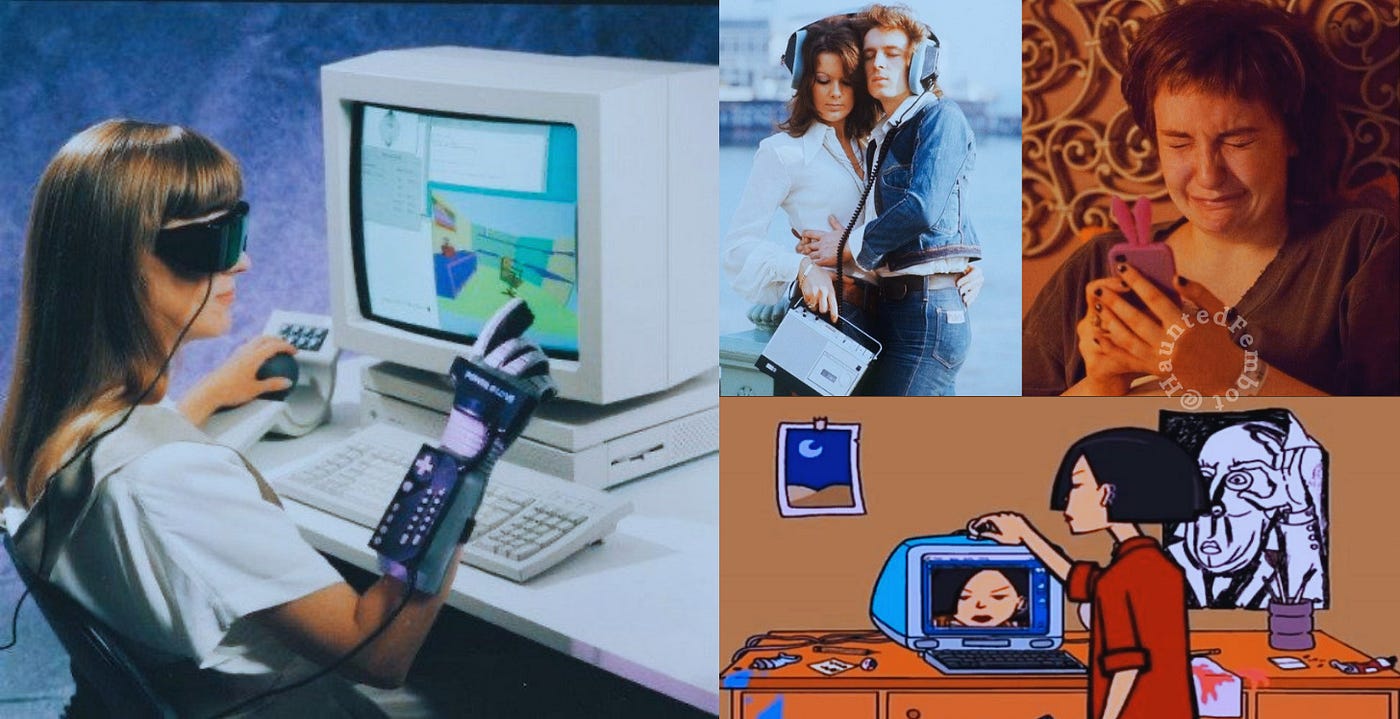
The average U.S. adult now spends over 7 hours per day on screens, with more than 2 hours and 24 minutes of that time dedicated specifically to social media use. As a wage-slave of the content creation machine, my daily phone time frequently reaches double digits. My personal tendency is to justify this time-suck with platitudes about productivity, convenience, and work-ethic.

The truth is- my smartphone is a prosthetic memory, a pocket mirror, a cyborg biographer, and maybe, most relevantly, the primary point of contact for any person or capitalist entity seeking my attention. Within its framework, everything from family group chats, to blowout sales, to world news are things I have the power to say, “yes”, “no”, or “maybe later,” to. And this perceived control, the idea that our devices somehow help us impose order, gatekeep our attention, and capture stability in an ever- changing hellscape, is what keeps us locked in.

Control Yourself

Pop psychology has given us a laundry list of scientific explanations for the smartphone epidemic: dopamine loops, overstimulation, behavioral conditioning. If you want to torture yourself, you can also reference millions of moral explanations (ranging from laziness to vanity) posted to Reddit, Facebook, X, and other virtual spaces where armchair philosophers convene. But at the core of all this is something simpler: the existential pull of agency.

Humans need to feel that their choices matter. That they are steering the ship. In this world turned upside down by health crises, natural disasters, algorithmic governance, institutional collapse, and social distrust, an authentic sense of personal power feels out of reach. So we indulge in micro-interactions that simulate choice to give us the vital feeling that we are still authors of our own experience.

Historical Context: Shrinking Your World into a Pocket-Sized Problem

The last five years have offered up a gluttonous serving of destabilizing events, fracturing any lingering belief in a safe, knowable world: a global pandemic, thousands of mass shootings, divisive political propaganda, wildfires, floods. Institutions have faltered. Narratives have splintered. And as a result, many of us are plagued by chronic existential terror and anxiety. Control, in this state, is less about action and more about sensation. And that’s where the smartphone steps in as an emotional pacifier. It offers a flattened version of the world, sized to fit in your hand. The existential gets miniaturized. The unimaginable becomes scrollable.

Wait a Second, Are They Monetizing Our Emotional Reflexes ?

Here’s the sinister part: the illusion of control is more than a byproduct of smart tech; it’s a feature. When you feel in control, you’re more willing to share, post, click, spend. You believe you’re navigating an open landscape of options. But really, you’re walking a narrow path carved by behavioral predictions and monetized attention. And the worst part, is that you’re actually feeding into a cycle of emotional disruption, consumption, and self-soothing that amplifies your anxieties. U.S. Surgeon General Dr. Vivek Murthy reported that in 2024, social media platforms were increasingly linked to heightened anxiety and depression among young people — enough to warrant proposed warning labels similar to those on packs of cigarettes. In a 2024 study, Pew Research Center found that 38% of teens acknowledge spending excessive time on their smartphones, with about 25% expressing similar concerns about social media usage; the same study reports that 44% of teens feel anxious, 40% feel upset, and 39% feel lonely when separated from their devices. Often, we are so distrustful of the mind’s natural ability to sort data, manage time, or cultivate intimacy without the aid of smart tech, that being separated from our smartphones feels something like an amputation. And this is by design. The more emotionally reliant we are on smart tech, the more we use it to mediate all of our life experiences and participate in a transactional relationship with Big Tech. Communication scholar, Dr. Emre Canpolat notes in his study on digital capitalism that “smartphones…inevitably result in the exploitation of users’ labour, the commodification of user data, the shifting of paid work into ‘leisure time’, and finally the transformation of everyday life through smartphones.”

Time is Money

Smartphones convert time into data. Every scroll is capital. Every photo is a piece of intel. Every app is a funnel designed to reduce friction between your attention and a marketplace.​

The more you “use” your phone, the more it uses you. This isn’t metaphorical. It’s an economic exchange: your sense of time is converted into commodifiable behavior. You feel productive because you’re sorting information. You feel social because you’re replying to DMs. You feel creative because you snapped a photo. But it’s a trap: the appearance of intention masking the reality of extraction.​

Closing Thoughts: Presence Over Simulation

When I took a three-week break from my smart phone, every suspicion I had about the algorithm was confirmed. My screen time had hi-jacked my brain, eroded my memory, and filled the gaps of my life with anger, resentment, shame, and other emotions that felt equally unpleasant and urgent. Without smart tech, I was forced to reach for other systems of organization. I wrote reminders by hand. I made recipe cards. I purchased a physical calendar. I had forgotten that I could impose order without surrendering entire days to a feed designed to agitate and distract me.

This isn’t an article about how I conquered addiction or solved a global crisis. I haven’t gone off-grid to live among the noble creatures of the rainforest (yet). This is just one perspective that is part of a much bigger, intersectional conversation. But if smartphone use is rooted, even in part, by a hunger for control, then the way out is intentionality and presence of mind.

College Level Timed Writing Guide

Writing Guide developed for The Moorpark College Writing Center in Moorpark, CA.
Audience: college students 18-30
Tone: informative, professional, and funny

How to Write a College-Level Timed Essay

1.READ THE PROMPT AND SCAN FOR KEY WORDS. DON’T BE A VICTIM OF MISUNDERSTANDING.

Read the prompt carefully. Make sure that you understand what your instructor is asking you to do.

Look for keywords to cue your response.
Common keywords and what they mean:
compare: describe the similarities between two concepts/ events
contrast: describe the differences between two concepts/ events
explain: contextualize and clarify a complex concept/ event
list: document a series of concepts/ events in logically organized group(s)

2. MAKE AN OUTLINE BEFORE YOU BEGIN WRITING. MAKE THE HARD DECISIONS FIRST. 

Why outlining is important:
a. An outline protects you from writer’s block
No one wants to turn in an essay  filled with an introduction, 3 crossed out sentences and a series of blank, shameful pages. Once you have a plan, you don’t have to worry about blanking out halfway through the test. 

b. An outline keeps you from rambling and going off topic
You can reference your outline as you get to new paragraphs in your essay to make sure that you are staying on track. This will keep your essay on the Cold War from turning into a review of Dr. Strangelove. 

d. An outline forces you to understand what you want to say before you try to say it.

3. USE THE COMPONENTS OF BASIC ESSAY STRUCTURE AS THE FRAMEWORK FOR YOUR OUTLINE.

COMPONENTS OF BASIC ESSAY STRUCTURE:

I. Introduction: Orients the reader to your topic and introduces your argument/ main point. 

a.Overview of your topic: Give us a tiny bit of history and let us know why this topic is relevant

b.Thesis: This is where you answer the prompt unambiguously! For a timed essay, don’t worry about being fancy. Just answer the question as clearly and simply as possible, so that you can move on to proving your point!

II. Body: This is where you will put all of your evidence and support! Your body is made up of several paragraphs, each one focusing on a sub-point of your thesis. For a timed essay, 2-4 body paragraphs is usually enough, but make sure to ask your professor what she/he expects. 

a. Topic Sentence: A sentence that states the main idea of your paragraph. 
b. Evidence: Examples from lectures & assigned readings that support your argument
c. Analysis: An explanation of why and how these examples support your argument. 

III. Conclusion: This is where you sum up your argument. 

a.) Don’t just rephrase everything you have already said, explain why your argument is relevant. In a persuasive essay/ argument essay, you are typically proving that there is a problem which must be changed. Explain what might happen if that problem were never addressed? Why do you want people to know what you’ve written? 

4. PROOFREAD! 

This is a timed essay; you don’t need to correct every mistake! Teachers hope for perfection, but they don’t expect it. Make sure to look over your essay when you are finished to avoid missing words, and other mistakes that make your ideas difficult to understand. 

5. USE THE CLOCK!

The clock is a tool that you can use to keep yourself on track, not a ticking time bomb that forces you into a sweaty panic! Use it to decide how quickly or slowly you should be working. Allot different amounts of time for each step in the writing process (e.g. Outlining- 10 min, Intro- 10 min, body- 30 minutes, conclusion-10, proofreading- 3 minutes), and force yourself to move on to the next step if you are working too slowly!